Sunday, August 9, 2015

Konnichiwa - Japan Part V (Hiroshima)

When visiting the grand country of Japan, travelers have a big decision to make after visiting the central part of the island. Most tourists spend a decent amount of time (if not they're entire time) in Tokyo, Kyoto, Osaka, and Nara. After that, you can choose to either turn north or south to continue exploring. We visited in 2012, just a year after the Fukushima nuclear meltdown, so staying away from the north wasn't only a personal decision but a government one. I would have chosen the south anyway, so that we could spent some time in Hiroshima, the city destroyed by the United States during World War II with an atomic bomb. I've mentioned before that I'm a huge history buff especially WW2 history. Hiroshima, for me, was a "must see"!

We woke up at 4:45AM the morning of Thursday, April 5 and caught the Sakura Shinkansen from Shin-Osaka to Hiroshima. The trip only took 1.5 hours because this high speed bullet train at times reached speeds up to 200 mph. The ride was so smoothe, we only realized how fast we were going by how quickly the scenery whipped by us. After arriving at the Hiroshima station, we walked to the entrance of our hotel that connected directly to the station and, once again, asked them to store our bags. (If you haven't realized this already, this method of storing our bags at the hotel worked out so well for us. We often arrived in a new city early in the morning. Unable to check-in until 2 or 3pm, every single hotel we stayed at graciously stored our bags. We've found this to be true all over the world. Don't hesitate to ask your hotel for this convenience if you ever find yourself in a similar situation.) The Hotel Granvia Hiroshima was by far the nicest hotel we stayed in out of the entire trip. Every major city had a branch of this popular hotel chain, but in cities like Tokyo or Kyoto, the going rate for a single night soared into the $500s or $600s. Hiroshima was overall much cheaper, and we got a room for 2 nights in this hotel for only $180/night. Given the significance of how much less we paid for this hotel, I'm positively certain we could have stayed in Hiroshima for a ridiculously cheap amount, but it was worth it to us to spend a few extra dollars (while still staying under my $200/night budget) and getting a really nice room. (And by really nice room, it was still tiny! All hotel rooms in Japan are tiny...like really tiny, but we probably had 25-30 more square feet in Hiroshima.) My trip advisor review basically says the same thing. 

By 9AM, we dropped our bags and made our way to the Peace Memorial. We took a short street car ride that dropped us off right at the A-Bomb Dome, a world heritage sight, in memory of the first atomic bomb. Looking at it, I always thought that it was a cathedral, but as it turns out, the structure opened in the early 20th Century as a building for arts and education exhibitions. Located 160 meters from the hypocenter where the pilot of the Enola Gay detonated Little Boy, it remained the only structure left standing due to its steel frame. Instead of tearing it down, Japan spent time and money reinforcing the weakened structure to prevent it from collapsing between 1950-1964, and then they built a peace park and memorial around it. 

A-Bomb Dome - Hiroshima, Japan

As we walked through the Peace Memorial from the A-Bomb Dome to the museum, we had a rather unique encounter. An elderly Japanese lady approached us and asked us if we spoke English. Prior to this, our encounter with all random strangers in Japan had been most pleasant, especially all of our experiences with older Japanese women. Additionally, we read in travel books prior to coming to Japan that it was not uncommon for Japanese people who lived through World War II to seek atonement from visitors. Very strange, right? On any other trip in Europe or elswhere, the guide books cautioned us against gypsies, pick pockets, scammers, street peddlers, etc. but never did we ever expect that there would be strangers wandering the streets just trying to be friendly. But when this lady approached us, we kindly stopped and chatted with her. She asked us questions about where we were from and how we liked the food. Then she introduced us to her grandson and said that he was studying English in school and hoped to travel to the USA someday. I know what you're thinking. This whole situation is incredibly weird. I know! It was weird for us too even while we were standing there. Not throwing all common sense out the window, I kept one hand on my cross-body purse the entire time (which had our cash, passports, credit cards, etc). My husband had his wallet in his back pocket, and he said that he always kept an eye out to make sure no one came up behind us. All travel cautions told us that this encounter was not honest or genuine, but they stayed at a decent distance from us, and her grandson couldn't have been older than 13 or 14. 

Then she asked to take our picture with her grandson. What? Wasn't this situation already bizarro enough? But being the stupid American tourists that we are, we agreed. The grandson clearly looked embarrassed by his grandmother, so he stood a good couple of feet away from us for the picture. Thinking that if ever they were going try and scam us, it would be during a picture, I make sure to clutch my bag extra tightly. Then...THEN, as if we weren't utterly confused already, the old lady wanted to give us gifts for our kindness. We politely refused, but she insisted.  

*Quick side note about Japan. If you've ever been to Las Vegas, you know that as you're walking down the strip, there will be guys handing out cards that advertise peep shows and exotic dancers. In Japan, they have similar same guys who are handing out ads (not ads for women, but for shopping stores, etc) but instead of the ads being on cards, the ads were printed on mini packs of tissues. We collected as many of these as we could and saved them because public restrooms often had toilet paper for pay or had no toilet paper at all. These little tissue packs really came in handy. Ok, back to the story...

The lady gave us these little tissues packs wrapped in cloth cases and a pin made from newspaper. 


Gifts from a random Japanese stranger

After giving us these gifts, she walked away. The entire encounter was only about 5 minutes at the most, but it left us standing there completely baffled. What just happened? We checked our pockets and nothing was stolen. We told ourselves that maybe it was as the travel books said. Here was this little old lady just trying to spread some goodwill with tourists? The only thing that made us question that is because later that day as we exited the museum, we saw that same lady chasing some other western tourist down the street saying, "excuse me sir, excuse me sir..." It was most bizarre. In hindsight, she had all the makings of a scammer though we didn’t have anything taken. Were we used as training for her grandson? Was it not a scam? We’ll never know. But this was by far the most unusual thing to have happened to us while traveling.

Memorial to the A-Bomb Victims

We then walked through the peace park to the peace memorial museum. We enjoyed the museum very much; the exhibits really impressed us! The first section gave us a bit of Hiroshima and Japanese history before the war, went through the war itself, explained the history of atomic/nuclear weaponry, and then the specifics of the bomb dropping and the rebuilding of the city. That first section was comprehensive enough that there didn't even seem to be the need for another section. We were sorely mistaken. The main portion of the museum centered around the effects of the bomb and the aftermath. Display cases featured artifacts that fused together during the blast, destroyed clothing fragments, and pictures of school-aged bomb victims. Later in the exhibit, we learned more about the aftermath of the war and the subsequent effects that bomb victims continued living with years later from cancer to discrimination. Hiroshima became a taboo place to live, and a-bomb victims became second-class citizens because they reminded the rest of Japan about the shame of the war. 

What I appreciated more than anything else about the museum was the truly unbiased approach the Japanese took with the exhibits. Being a student of historical methods and having sat through class after class about the importance of unbiased history, I've also learned that when you have personally experienced something, bias is inevitable. In the last exhibit, the Japanese use the museum to make their best attempt to convince visitors of the need to rid the world of all nuclear weaponry.  The Peace Museum could have easily attacked the United States and denounced them for this unforgivable action which thrust the world into the nuclear age and decimated two cities and hundreds of thousands of innocent lives. (Much like the museum in Paris that barely mentioned role of the United States in the war against Nazi Germany.) Instead, throughout the last exhibit, Japan took full ownership for instigating the US involvement in the war. They acknowledged that their imperialistic ways and attack on Pearl Harbor sealed their fate. I was honestly shocked that they didn't place any blame on the United States. Not that this surprised me. Everything we had learned about the Japanese people so far, and everything we've learned about them since has only reaffirmed what an honorable and genuine people they are.  But I'm getting side-tracked. 

After the museum, we got lunch on the go from a 7-11. Sounds strange, but it was very authentic and delicious. We really hadn't had too much sushi up to this point and our trip was more than halfway over. The most remarkable thing about this lunch wasn't the food itself but our venue.  We couldn't find any trashcans. This is true of the whole country. They very much follow a "take your trash with you" motto. We found the 7-11 in a train station where they had lots of seating in the middle with free wifi. (Kind of like a food court in a mall.) Unlike an American food court with trashcans everywhere, here, we couldn't find a single one. Not a single one! We ended up carrying our lunch trash around with us for the majority of the afternoon.

7-11 lunch in Hiroshima, Japan

Next we made our way to Hiroshima castle. Although the bomb in August 1945 leveled the original, Japan promptly rebuilt the castle in 1951. We toured the museum on floors 1-4 and enjoyed the observation deck on floor 5. We then took a break with cocoa and milk tea from a beverage machine inside the observation deck. 


Hiroshima Castle

From the castle, we walked to a Japanese tea garden called Shukkeien. Some cherry trees were finally blooming! Here, we saw yet another wedding taking place, and we read all sort of plaques about those who took refuge here after the bomb. We fed the fishes in the koi pond along with a ton of Japanese children and then walked back to Hiroshima station. 


Shukkeien - Japanese Tea Garden

In a previous post, I mentioned that the Japanese shopping malls were often multiple stories high and that they had both groceries and prepared food on the lower levels. That evening for dinner, we decided to give ourselves each Y1000 (or about $10) to buy an assortment of prepared food from this market called Fukuya. Since our Hiroshima hotel room was actually large enough for a table, we brought our “treasures” back to eat at the hotel after checking in.  

Dinner from the Fukuya department store in Hiroshima, Japan

We had one more full day in the Hiroshima area, but instead of spending it on the main island, we took a reprieve from the cities, castles, and temples, and traveled out to the island of Miyajima for a day of nature and hiking. We didn't know what to expect, but the signs cautioning us against vipers (yes, vipers!) made us a little leery. But more on that HERE to keep reading. 

Thanks for reading!

- Foxy the Traveler

Saturday, August 1, 2015

Konnichiwa - Japan Part IV (Osaka & Nara)

Springtime in Japan is very much like springtime in the United States, often rainy and unpredictable. We visited Japan in early April and for the first half of the trip the weather was mostly cloudy with spurts of sunshine. After Kyoto, we spent one full day in Osaka during which we experienced our first truly rainy day...and then some. 

We took an early bullet train (Shinkansen) from Kyoto (read about Kyoto Day 1 and Day 2) to Shin-Osaka. We chose to stay in Shin-Osaka because the Shin-Osaka station connected to more major cities than Osaka. Our hotel, just a short walk from the station, stored our bags for us until we checked in later that day. Read my trip advisor review about the Honkan Shin-Osaka Station Hotel. Overall, for being one of the most inexpensive hotels we stayed at ($70/night) we thought the value was fantastic!

Unlike Kyoto, our JR rail passes worked perfectly everywhere in Osaka. After dropping our bags at the hotel, we took the train one stop from Shin-Osaka to Osaka. Umbrellas in tow, the rain cleared a bit as we approached Osaka castle. Japan rebuilt Osaka Castle in 1945 after being completely destroyed during World War II bombings. You can see from my pictures what a dreary day we had. In my picture album, I have these pictures below beside a postcard of Osaka Castle with trees in full bloom beneath a cerulean sky. 

Osaka Castle

Osaka Castle

After the castle, we took a walk through Shitennoji Park then found ourselves some delicious seafood pasta for lunch at a small cafe. As we walked through the streets of Osaka we noticed the skies becoming increasingly unfriendly looking. Armed with only tiny umbrellas, we knew this would do us no good against the wind gusts. Suddenly the heavens opened and torrential rains came down from the sky. We first took cover under some tori gates of a temple. After about 20 minutes, an elderly Japanese lady came out and wanted to close the gates. Unable to communicate, she made some sort of gesture implying that we were welcome to stay after she closed the gates, but we politely bowed and took our leave. Our second place of shelter was under the awning of a Japanese nursing home. We stood there with several others for about 15-20 more minutes (all the while the rain was pouring as heavy as ever with insane wind gusts) until a large bus pulled up and started unloading residents as if returning from an outing. Between the all of the staff helping the residents and the barrage of wheelchairs and walkers, we took our cue and continued on.  The last place we hid was under the awning of an apartment building (getting completely soaked each time we ran from cover to cover). The high winds deemed our umbrellas completely useless. As we stood there, we chatted a bit about how few people we saw on the streets. Where did everyone go? Why weren't there more people running and hiding under protective covers like ours? As the rain let up a little bit, my husband recommended making a run for it to try and find the nearest train station. Like Tokyo and Kyoto, he suspected that Osaka too had an entire underground world beneath the city. We didn't even run for a few minutes before we found the entry to the subway. And sure enough we discovered a shopping complex of gigantic proportions. One could walk from station to station completely connected by underground tunnels with restaurants and boutiques for one's convenience. So THAT'S where everyone went! Smart! :-)

*One side note about the rain storm. We saw images of the storm on the news that evening. Apparently we weren't the only ones who couldn't use our umbrellas. The evening's feature showed pictures of the city streets with hundreds and hundreds of discarded umbrellas stacked in piles. No horrible crime, political scandal, or social unrest...not in Japan...just umbrellas. Lots and lots and lots of umbrellas (opened umbrellas at that) left by citizens and tourists trying to escape the unexpected monsoon-like storm. 

After the weather cleared and we dried off a bit, we made our way to Dotonbori Street near Namba. A street only for pedestrians, Dotonbori had restaurants, all manner of shops, and Pachinko parlors (aka enormous multi-story arcades with games ranging from ski-ball and pac-man to actual gambling games).

Dotonbori Street, Osaka

Dinner that evening was the most unfortunate of the entire trip. Compared to our delectable, traditional Japanese dinner the previous evening in our Kyoto Ryokan, our dinner in Osaka was barely edible. Our method of ordering usually consisted of pointing to pictures on the menu, pointing to plastic food displays in the front (which were surprisingly elaborate and accurate) or on the rare occasion, the waitress either spoke a little english or brought us english menus. In Osaka, we simply pointed to pictures in a completely Japanese menu. I thought I simply ordered a bowl of ramen with an egg and some pork strips on the top, and this is what they brought me. 

Ramen dinner in Osaka

The first thing that struck me as unusual was the fact that the main dish came in a metal bowl. Strange right? After proving myself a true tourist by photographing our dinner, I saw something else that caused some alarm...condensation on the outside of the bowl. Condensation?! Maybe it was just wet from being clean or something, right? Fearing the worst, I placed my hand out the outside of the bowl and then pulled in back in absolute horror. The bowl was...COLD! Cold? COLD!?! Maybe it wouldn't be that bad. Just because it was cold didn't mean it was bad, right? Nope. Not only was the entire dish cold, it was....wait for it...pickled! The broth had a strong vinegar base consistent with the pickled vegetables they served us at almost every meal. It really was one of the most disgusting things I've ever eaten. My husband graciously shared his dinner with me and attempted to eat my pickled ramen, but even his iron taste buds could only stand a bite or two. 

After dinner we made our trek back to Shin-Osaka and called it a night. We spent two nights at the Honkan Shin-Osaka Station Hotel in Shin-Osaka but only one day in Osaka itself. On our second full day in Osaka, we took a day trip to the nearby town of Nara. What started off as a sunny, mild day, became blustery and quite unpleasant as soon as our train arrived in Nara. It only took us about an hour by train to get there, and we still greatly enjoyed the day despite the chilly, windy weather. 

Positively, the most remarkable thing about Nara was all of the tame deer. In the eastern United States  where I'm from, we're certainly no stranger to deer, though they're mostly jumping in front of cars or dashing away from you if you get within 25 feet of them. Nara deer were not afraid of people or cars. In fact many street vendors sold deer "cookies", and you could see the deer casually walking all over the city. For someone from the mid-Atlantic region, this sight baffled and amazed me. 

Feeding the deer some "cookies" 

Tame deer walking the streets of Nara

The chance of seeing tame deer enticed us to spend a day in Nara, but the temples intrigued us too. We started at the Kofuku-ji temple, but scaffolding covered the main part of the temple as part of an ongoing restoration project. I loved the Toda'ji temple that housed the giant Buddha. I took some pictures of the funny, poorly translated signs (which are everywhere in Japan and make up 2 full pages of my scrapbook) and then we walked across the yard toward the entrance. 

Toda'ji Temple, Nara

Giant Buddha in Toda'ji Temple, Nara

The picture doesn't do justice to the true size of this magnificent statue. After the Toda'ji temple, we walked around and saw some more shrines, enjoyed some hot tea in a strange but warm and cozy rest station, and found ourselves some delicious hot lunch in a small cafe. Our friendly waitress spoke surprisingly good english and helped us learn the difference between a few food items which helped ease our food ordering in the future. 

After lunch, we walked around a few more shrines and found a covered shopping street with a fun 100Yen store (the equivalent of a dollar store in the US). We got Y420 worth of yummy snacks, enjoyed some confectionery refreshments at a Mister Donut and then made our way back to the train station. We stopped first at Osaka and spent some time in a multi-level shopping mall before heading back to Shin-Osaka. Multi-level shopping malls are everywhere in Asia. The mall is often at least 7-10 stories high with a specialty item on each floor like electronics, apparel, cosmetics, etc. Then they usually have at least one or two lower levels with prepared food and grocery items. We often found our breakfast for each morning in these mega shopping malls. 

Our next morning had a super early start, so we grabbed a quick noodle dinner (hot this time) in Shin-Osaka and turned in by 8pm. A super high speed train the next morning took us to Hiroshima, the site of the first atomic bomb. Look for my Japan Part V blog coming up next for a most bizarre experience that still baffles us to this day. Until then friends thank you so very much for taking a few moments of your time to read about my silly adventures abroad.  

Thanks for reading!

- Foxy the Traveler

Sunday, July 19, 2015

Konnichiwa - Japan Part III (Kyoto Day 2)

Welcome to our second full day in Kyoto, Japan. After another difficult night and morning in our tiny, windowless, musty, smokey room we checked out of the Hotel Hokke Club and stored our bags at the reception desk for the day. Read about our first day in Kyoto and the yucky hotel we stayed in here.

For Kyoto Day 2, we finally had a beautiful, sunny day. Still on the chilly side, I was just happy to have some sunshine. We wasted no time getting a jump on the day and set out for one of the most beautiful temples of the entire trip: Kinkakuji. Kinkakuji sounds a lot like Ginkakuji, does't it? Ginkakuji is also known as the Silver Pavilion while Kinkakuji is also known as the Golden Pavilion. Surrounded by a picturesque pond, we really enjoyed our time at this temple. Definitely one of our favorite places in Kyoto!

Kinkakuji: The Golden Pavilion

From Kinkakuji we tackled the Kyoto bus system and saw the Ryoanji Rock Garden, Ninnaji and  Daikakuji Temples that were all in the far northwest corner of the city. It didn’t even feel like we were in the city anymore. The rock garden made us laugh. See the picture below. Imagine an outdoor swimming pool that's only about 2 inches deep and filled with little tiny rocks raked in perfectly measured rows and circles around a couple of large rocks. Then add 5-6 positively packed rows of bleachers filled with people sitting and staring at these pebbles. Don't get me wrong, we enjoyed seeing it. The amount of time it must have taken the monks to rake the stones with such precision amazed me, but I didn't need to stay for more than 10 minutes looking at it. When we first arrived, we  couldn't find anywhere to sit. We stood for a few minutes and then took the seats of a couple as they left. We probably sat there for about 10 minutes more amused by all of the people than by the rocks. The people around us sat in absolute silence. What mesmerized them about this place? How did these rocks inspire a contemplative or meditative state? I'm sorry to say that we really found the whole thing incredibly amusing. Without being overly rude, we sat quietly giggling to each other about how little understood about the significance of this place. By the time we left, the only other pair to leave was the couple that gave us their seats. No one else got up or even looked like they were going to move. To this day, I still don't get the allure. 

Ryoanji Rock Garden

I highly recommend the Ninnaji Temple. The large complex had multiple buildings with furnished rooms that really gave you a good example of ancient Japanese living. Most of the other temples only allow visitors to view the shrines for prayers, but at the Ninnaji Temple we explored from building to building across wooden platforms...in our socks of course.

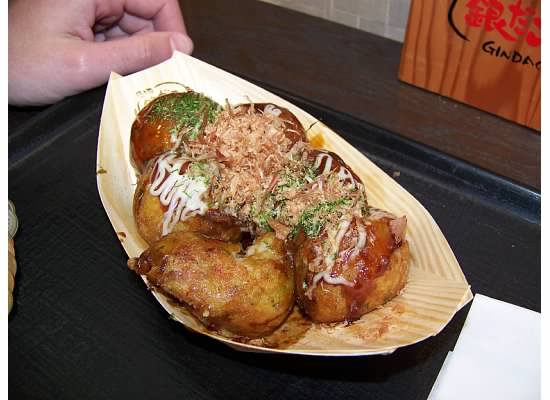
After visiting our last temple and taking off our shoes for the um-teenth time, we finally make our way back to Kyoto Station around 3pm. We hadn't eaten lunch yet and survived the day so far on some snacks I had in my purse. My husband took advantage of this opportunity to try the Octo-balls we'd been seeing everywhere. Why are they called Octo-balls? Because they give you 8? If you look at the picture below, you'll notice there are only 6. Hmm, why else would they be called Octo-balls? Maybe the pictures below will help you figure it out. 

Fried Octo-balls!

Sign above the Octo-balls stand!

Why yes friends, you have probably correctly deduced that the Octo-balls are, in fact, made from octopus. I don't know if I've mentioned it yet so far in my blog series, that I am probably one of the worlds pickiest eaters. My parents still tease me that when I was a kid, I would only eat Campbell's chicken noodle soup. I like to think I've come a long way since my chicken noodle soup days, but fried octopus balls? I'm sorry. I'm still WAY too picky (or perhaps timid) to try those. Later in the trip when my husband ordered this delicious Japanese seafood pancake, you could even see the octopus tentacles. Eeeek! That was just too much for me! I am definitely not a brave travel eater. 

After our unique dining adventure, we went for a walk in "downtown" Kyoto to find our Ryokan for the night before schelping our bags all over the city like we did when we first arrived. Ryokans are the Japanese version of a bed and breakfast with extra finesse. In addition to a place to sleep for the night with breakfast the next morning, most Ryokans include a traditional Japanese dining experience and access to an onsen or bath house. You can read my full review of Ohanabo on Trip Advisor here, but this place was incredible! We specifically chose it because it was within walking distance of Kyoto Station. They had different types of rooms available including ones with and without private bathrooms. We booked a room with a private bath but in hindsight, it wasn't necessary. The onsen at Ohanabo was immaculately clean and very private. 

Ohanabo Ryokan - Kyoto

I'm glad we took a walk to find our Ryokan before going straight there with our bags. We found the street easily enough, and I recognized the exterior from pictures on their website. Once we got there, they had a very small sign confirming that we found it. Across the street from Ohanabo was another temple that we hadn't seen or heard too much about. The exterior was absolutely enormous, so big that I couldn't even capture the entire structure in a single photograph frame. I took two pictures of each half and put them together in my photo album. This temple (who's name I sadly never wrote down) was badly damaged in the 2011 earthquake. Scaffolding coated the interior and you could scarcely see anything other than a shell of the structure.

Temple undergoing repairs.

After dropping some yen in the restoration fund, we collected our bags from our smokey hotel and checked in at the Ohanabo Ryokan. What an incredible experience. We enjoyed a traditional Japanese dining and sleeping experience...on the floor. Our evening began by donning authentic Japanese clothing, pre-dinner green tea followed by a scrumptious fare of classic Japanese cuisine. 

Enjoying some green tea before dinner.

Traditional Japanese dinner on the floor

After dinner, they cleared the table and chairs and set up fluffy floor mattresses, down feather quilts, and the most bizarre pillows. Instead of pillows that we're used to in the United States that are filled with stuffing of some sort, little beads filled these pillows. My husband and I were both skeptical about the type of night sleep that we would have, but we slept very comfortably. I don't know that I would want to spend multiple nights sleeping on the floor, but the experience for one night was perfect.

In the morning, we ate a traditional Japanese breakfast of smoked salmon, cooked tofu, salad, cooked egg squares, little cakes, miso soup, assorted pickled vegetables, tea, and steamed rice downstairs in their communal dining rooms. We opted not to wear our Japanese garb in the morning and noticed that no one else in the dining room wore them either. About half way into our breakfast, another western couple entered the room wearing the Japanese clothes and suddenly looked embarrassed when they saw no one else wearing them. Kudos to them, however, for sticking it out. 

After breakfast, we collected our belongings, checked out, and headed to Kyoto Station to catch the Shinkansen to Shin-Osaka. Instead of using our tickets, we caught an earlier train. On the Shinkansen, they have rail cars dedicated to passengers with specific tickets. They also have rail cars for untimed tickets with seats that are first come first served. We easily got seats in the open car, and got to Osaka an hour earlier than we planned.

Look for my next blog about our days in Osaka and Nara. Click HERE to keep reading. 

Thanks for reading!

- Foxy the Traveler

Sunday, June 28, 2015

Konnichiwa - Japan Part II (Kyoto Day 1)

Kyoto is one of the most popular tourist destinations in all of Japan after Tokyo. Unlike the major cities of Tokyo, Osaka (and obviously Hiroshima), Kyoto was spared from heavy Allied bombing during World War II. This means that their centuries old temples still exist without heavy restorations or even rebuilding after the war. Paris is called the City of Light; NYC is the City that Never Sleeps. Kyoto should be the City of Temples. There are so many temples that one could easily spend several days exploring Kyoto, never seeing the same temple twice. My husband and I spent two full days here. For as much as we enjoyed it, we became saturated with temples. The same thing is true if you visit too many castles or cathedrals in Europe. After a while a pagoda is another pagoda, a buddha is another buddha, and you see tori gates everywhere. That should not discourage you from going to Kyoto, but just a suggestion that you pace yourself. See the really unique temples and find some other interesting things to do. 

We arrived in Kyoto late in the afternoon after a 3.5 hour Shinkansen train ride from Tokyo. I was so excited to take the trains from city to city so that we could see the countryside and rice fields in between the cities. Well, I was slightly disappointed with the train from Tokyo to Kyoto because there was no countryside. Japan is one densely packed island, and between the two cities was neighborhood after neighborhood. The city never seemed to end. I loved seeing Mt Fuji off in the distance but the peaceful countryside I expected, didn't exist. 

Our train arrived at Kyoto station, and much like Tokyo station, Kyoto station also beats out any USA train station in terms of grandeur, amenities and beauty. This multi-level architectural marvel had floor after floor of restaurants above ground and an underground shopping mall called Porta with more eateries.

Kyoto Station

Upon arrival we first set out on foot to find our hotel. We booked our first hotel in Kyoto on Agoda.com. Kyoto gets incredibly expensive during Cherry Blossom season, and hotels quickly sell out. We had difficulty finding anywhere to stay and thought ourselves lucky when we found the Hotel Hokke Club for around $200/night. We prepaid for the rate and noticed on the webpage that only smoking rooms were available. We're not smokers but not seeing any other options, we went with that room hoping we could ask for a nonsmoking room when we arrived. Unfortunately, the hotel insisted on giving us the room we booked which we endured for 2 nights. The horrid smoke smell aside, the room size and bathroom layout made things most difficult for us. Overall, this was our worst hotel stay of the entire trip. You can read my full trip advisor review for some more specifics.

Photo taken from the doorway. Could this room be any smaller?

Look very carefully at the plumbing.
One could not shower and use the sink at the same time.

In Kyoto, they have one or two underground subway lines that are on the JR passes that we had, but those train lines weren't suited for our tourist needs. Instead, we planned on using the bus system. During our research before the trip, we read high praise about the Kyoto busses. We bought 2-day tourist passes for Y4,000 ($50/for 2). 

We set out for our first temple of the day, Sanjusengen-Do or the home of 1,001 Buddhas. Each bus stop had one of these signs. The sign told you each numbered bus that came to this particular stop, and the green circular button you see below moved indicating which bus arrived next. The tourist/bus map we got from the ticket office had excellent directions on which busses went to which temples. We found it incredibly easy to figure out which bus we needed to take.


Kyoto bus stop

While seated on the first bus, we noticed quickly that the automated bus stop voice thingy only announced the stops in Japanese. We frantically pulled out our tourist map and tried to count the number of stops until we needed to get off when all of the sudden in clear English, the automated voice said, "exit next stop for Sanjusengen-Do temple." <<OMG! Thank goodness!>> This happened again and again throughout the day. Someone later told us that prior to the Nagano Olympics in 1998, the International Olympic Committee told Japan that they needed to make their more popular tourist attractions more foreigner friendly. So, they added English to the popular bus stops which helped us know where to exit. 

Our days in Kyoto were on the chilly side. I mentioned in my post on Tokyo that Japan had an unseasonably cold winter that lingered into March when we visited. At all Japanese temples (and in Thai temples too we later learned), we had to remove our shoes. This certainly didn't bother us, and out of respect we were only too happy to comply, but walking around in socks in an unheated temple on a 40 degree morning was a little unpleasant. 

The age of these temples really impressed me. Inside this particular temple, there literally stood 1,001 Buddhas all in a row (about 5 Buddhas deep and about 200 abreast). We weren't allowed to take any photographs inside the temple, but they did have postcards available for purchase at the small gift shop. Has that ever happened to you while traveling? You see something amazing, but photographs aren't allowed? Read my postcard tip from a previous blog post. I bought postcards all over the place in Japan.

Sanjusengen-Do Temple - Home of 1,001 Buddhas
Walking around the grounds of Sanjusengen-Do

After Sanjusengen-Do, we hopped back on a bus to one of the most famous temples in all of Kyoto: Kiomizu-Dera. If you have to choose a season in which to visit Japan, it will be tough choice between  Spring and Fall. Spring, while chilly and often cloudy, is full of beautiful blossoms (even though we missed them during the first half of our trip). If you go to Kyoto in the Fall, however, you have the chance of seeing Kiomizu-Dera surrounded by brilliant red maples. Cherry blossoms are the first flowering trees to bloom in the spring, often before any other trees are even budding. Japan was no different. The cherry trees were just starting to bud and no other deciduous trees even had leaves on them yet. But look at this image below and imagine all of the trees having vibrant, red leaves. Google Kiomizu-Dera in the Fall to see what it can look like. Ah! Stunning!

Kiomizu-Dera, Kyoto

After Kiomizu, we took the "scenic" route to Ginkakuji also knows as the Silver Pavilion. We went for  a walk and found what we thought were the tori gates marking the entrance to Ginkakuji, but they weren't. We walked down a lovely shaded path that eventually led to a small tea garden. I wish I had taken a picture of that place because what remains of it in my memory is slowly fading away. On the way back, my husband took advantage of this detour to explore some more, founding a different route for us. Although terrified that we were lost, I really enjoyed walking through the residential neighborhood that we found. I loved seeing laundry hanging out to dry and women pulling weeds from their flower beds. Sometimes when I travel, I forget that although a destination is foreign to me, it's home to others.

After a 10-15 minute walk off the main street, we reconnected with the route to Ginkakuji. Before too long, we came upon the actual entrance to Ginkakuji and laughed that we ever mistook something else for it. A classic tourist attraction, there were food vendors, souvenir shops, etc. A sight that would normally make me roll my eyes, instead was quite welcomed by my famished stomach. We enjoyed hot dogs, fried potato spirals, and sesame and chocolate ice cream before making our way to the actual temple.

Ginkakuji - The Silver Pavilion

After Ginkakuji, we made our way to the historic Geisha district, Gion. Our main objective was to find an ATM. We took out Yen at the airport when we arrived in Tokyo, of course, but we didn't realize how cash dependent Japan would be. By day 3, we already found ourselves low on cash. This did not bode well for souvenir shopping! :) We walked for a very long time without any success of finding a compatible ATM. We read ahead of time that this could be an issue, and that the best way to find a ATM compatible with American cards was at 7/11's. In Tokyo, 7/11's are everywhere. In Gion, apparently they were scarce. After walking down street after street, we finally found one. Crisis averted! Now I can buy me some pretty things!

Crossing a pedestrian bridge looking over Gion

With colorful Yen in hand, I wasted no time. I bought two decorative fans and a handmade piece of fabric with a beautiful design on it that I later framed. 

At night, we went to Nijo Castle. During certain times of the year, they have an exhibit called, "Nijo Castle at Night" where they have special spot lights set up to highlight the different flowering trees. Unfortunately for us, this was a bust. There were trees. There were lights. There were no blooms. See my picture below. Can you imagine how beautiful this grove of trees would be when the branches are full of blossoms? So, what did I do? You guessed it. I bought post cards of what we were supposed to see. In my photo album, I have a page that says, "Nijo Castle at Night. What we were supposed to see vs. what we actually saw." 

We purchased the tickets in advance, so even though we knew the trees weren't blooming, we still went anyway. It's an experience we'll never forget even if it wasn't the experience we expected. 

Niji Castle at Night

Back to our smokey hotel for the night, we have one more full day in Kyoto before continuing on to the big city of Osaka. Click HERE to keep reading. 

Thanks for reading!

- Foxy the Traveler

Sunday, June 21, 2015

Konnichiwa - Japan Part I (Tokyo)

Japan, how do I love thee, let me count the ways....

Those of you following my blog have hopefully realized by now that my goal is to be very frank and candid about my experiences visiting different parts of the world. I simply adored Italy, was rather disappointed by Paris, felt at home in the French countryside, enjoyed England very much, was pleasantly surprised by San Francisco and Yosemite, and felt highly taken advantage of in Alaska. After such a let-down in Alaska, my husband and I took an entire year off of traveling by ourselves. We spent two of our vacation weeks in 2011 traveling with our families instead. We traveled to Las Vegas with my husband's parents, brother, and nieces, and then to Disney World in Orlando with my parents, sisters, their future husbands, and some aunts, uncles and cousins. In the fall of 2011, almost full year after Alaska, we started thinking about where else in the world we wanted to visit. Europe fell off the list for the time being as we started considering more exotic destinations like Egypt, Morocco, Fiji, and Asia. Political and social unrest kept us from Northern Africa for the time being, so we started looking more seriously at Asia. Immediately we circled around Japan. We already liked the Japanese things we could experience in America like sushi, Anime, Square Enix video games like the Final Fantasy collection, etc., and I was only too excited to visit historical sites like Hiroshima and all of the ancient Japanese temples. 

Not wasting any time, we started looking at the calendar for the best times of year to visit. One thing that stood out to us immediately was cherry blossom season. Having previously experience the mania that is the Cherry Blossom Festival in Washington DC, we knew that the Japanese cherry trees wouldn't be more beautiful anywhere else than in Japan itself. Now the difficult part: figuring out the timing of the blossoms. Like the USA, Japan had websites that tried to predict the peak bloom dates for their cherry trees, but you can never rely on that completely. We booked our trip around the best dates that we could and hoped for the best. One thing we learned quickly while planning, Japan is expensive! OMG guys, Japan is SOOOOO expensive. I've said before that I always start with a $10,000 budget for any international, 2 week trip. After seeing how expensive the hotels were and the transportation sticker shock, I bumped my budget up to $11,000. I am very pleased to report that, however, that we successfully spent to amazing weeks in Japan for just over $8,000 which is similar to almost all of our 2 week trips.  Here is the breakdown of what we budgeted vs. what we spent.

                          Budget Actuals
Flight $2,500 $2,162.20
Hotel $3,000 $2,437.13
Food $1,500 $484.42
Activities $1,200 $243.14
Souvenirs $500 $450.13
Transportation  $1,300 $1,373.38
Misc. $1,000 $871.29
Total $11,000 $8,021.68

For more details on how I get create my budget in the first place, check out one of my earlier blogs: Planning Your Budget: Domestic vs. Foreign Travel. The long and the short of it is that Japanese hotels and transportation were wildly more expensive than we ever thought, but while there, we unintentionally ate very cheaply. The activities we did also ended up being much cheaper than we planned. But more on that later. 

In advance of our trip, we booked our flights, all of our hotels, and we purchased our Japan Rail (JR) Passes. The Japanese drive on the opposite side of the road than the United States (same as the UK) and many tourist books and websites cautioned us against driving. If we ever go back, we might consider driving to visit the more remote parts of the country, but for our first adventure, we got everywhere we needed to go with the amazing Japanese high speed train system called the Shinkansen. All of our hotels were within walking distance to a major train station, and the JR passes took us everywhere we wanted to go. 

There were several flight options we could have taken. United Airlines and All Nippon Airlines both offered 1 nonstop flight per day from Washington DC to Tokyo/Narita, but they were very pricey. We instead opted for an American Airlines flight with a connection in Dallas/Fort Worth. The flight from Washington to Tokyo is a horrid 13-14 hours (which we ended up doing in 2015 as part of our 20 hour flight from Washington to Bangkok), but from Dallas, it was only about 10 hours. Rest assured, 10 hours on a plane is still pretty lousy, but surprisingly, the time passed quickly. We slept for the first half of the flight in our best attempt to adjust to the time change as early as we could. Our flight from Washington left at 6AM on a Wednesday morning, and we landed at the Tokyo/Narita airport at 1:30PM on Thursday afternoon. It sucks that traveling to the other side of the world makes you lose an entire day. At least you recover that day (sort of) on the way home. 

The Tokyo/Narita airport is a good bit of distance away from Tokyo itself. Our first order of business in the airport after landing and clearing customs was to take our voucher for the JR passes and pick up the cards that would be our lifeline for the next two weeks. I'm not going to lie. The JR passes are crazy expensive, and I mean cra-cra expensive. (We're talking $600/each.) BUT, the ease of travel we got from having them was nothing short of fantastic. The JR passes mean that we could travel on any sort of JR transportation line (city subways, intercity high speed trains, etc) without any sort of additional fees. We didn't have to stand in any lines at a subway station for tickets, and we could go to any ticket counter we wanted, flash our JR passes, and immediately go through. When it came to traveling between cities, we showed them our valid JR passes, and we could get timed tickets for any outbound train with assigned seats. I can't gush enough over how convenient these passes were. Expensive? Yes! Worth it? OMG, yes! Yes! Yes! 1,000 times yes! (And just a quick side note. I intend to talk lots more about how amazingly friendly and honest the Japanese people are. My first example is the fact that one day, we DROPPED one of our precious JR passes. This golden ticket that gave us unlimited transportation for the entire duration of our visit could have been gone in a moment. Had we been in NYC or really any major metropolitan city outside of Japan, we never would have seen it again. Instead, a very kind and honest Japanese person turned it in, and we got it back.)

Yikes!  This blog post has already gotten way too long, and so far we haven't even left the airport. So, after we got our JR passes, we hit the ATM for Yen, and found the Narita Express which is the high speed train that takes you from the airport to Tokyo Station. In just over 50 minutes, we found ourselves in the heart of Tokyo in their famous, historic Tokyo Station. The closest comparison we have in the United States to Tokyo Station would be Grand Central Station in NYC. In terms of sheer size, Tokyo Station is its own little city. With a plethora of restaurants, shops, and platforms for different types of transportation, one could very easily get lost (an we did...often). Our Tokyo hotel: the Hotel Metropolitan Marunouchi, had an entrance just outside Tokyo Station. The problem? There were lots of exits out of Tokyo Station. Which one was ours? After wandering around like a mouse in a maze, we finally found the right exit, and cemented its location into our brains. You can read more about this hotel in my Trip Advisor review. Bottom line, it was expensive, tiny and perfect! We even recommended it to friends who stayed there a few months ago. They praised it highly as well! 

After checking into our hotel, we washed off the airplane scum, and ventured out to enjoy our first evening in Tokyo. We took the Yamanote circle line to the Akihabara station. This place gave us our first taste of the modern/technology side of Japan. This neighborhood was full of electronics stores selling everything from video games and gaming systems to the tiniest electronic parts where you could build/repair your own computer. We got our first authentic Japanese dinner from a ramen restaurant and called it a day.

Akihabara, Tokyo


Our tiny room at the Hotel Metropolitan Marunouchi hotel


Our view from our Tokyo hotel at night! Amazing!


After a good night sleep, we woke up bright and early for our only truly full day in Tokyo. Our first stop was to visit the Imperial Gardens which was just a short walk from our hotel. Unfortunately, the Imperial Gardens are closed on Fridays. Oops. Well this threw a slight wrench in the day because it was only 6:30AM and most things didn't open for quite some time. But we didn't let that get us down. We walked back to Tokyo Station and took the train to Ueno Station. Ueno Park is famous in Tokyo for having a street lined with cherry trees and also being the home of many different sorts of museum (history, science, etc.) in addition to a wildly popular zoo. When we got there, of course, everything was still closed and the park was pretty deserted. Why, you ask? Well, see for yourself....


Ueno Park & Cherry Trees...do you see any blossoms? 

How about now? I see 1 tree in bloom. The others? Nothing...

Looks like we got to Tokyo too early for the cherry blossoms. Unlike Washington DC where the cherry trees bloomed early that year, it was an unseasonably cold winter in Japan, and the trees were all slightly behind schedule. 

Ok, so far we went to the Imperial Gardens that were closed, Ueno Park without cherry blossoms, and its still too early for things to be open. Hmm...not the best start to our first day. But determined not to get discouraged, we looked down our list of things to do and decided to walk for about a mile to the neighborhood of Asakusa to the Senso'ji Temple (free entry). It was opened when we got there, but the pedestrian street that led to the temple lined with shops on either side, were all closed still. Honestly, that didn't bother us. They looked like a bunch of trinket and junk shops which I happily skipped. The temple was lovely and smelled of incense. The morning was cloudy, so my pictures didn't turn out too well. 
Senso'ji Temple - ancient Buddhist Temple

From the Senso'ji Temple, we backtracked to Ueno Park now that things were starting to open up. We went to the Tokyo National Museum (about $15 for 2) for about 1-2 hours and learned a great deal about Japanese history. Both my husband and I commented on the fact that throughout all of our years of schooling, we never studied Japanese or Chinese history. I loved seeing all of the artifacts from the different periods in history and appreciated all of the English translations. 

From Ueno Park, we headed over to one of the most famous historical sites in all of Tokyo: the Meiji Shrine. This Shinto shrine is enormous and the grounds are very extensive. In the court yard in front of the shrine, we saw this traditional wedding processional coming through. It would be the first of several weddings we saw throughout our trip. 

Wedding at Meiji Shrine

After the visiting the shrine, we paid extra money (Y1000 or about $13.00) to visit an Iris and Azalea garden near Meiji, but since neither were in bloom, the garden looked rather barren. If you're not visiting during the right time of year to catch these flowers, you can skip this. Otherwise, I'm sure it would have been lovely. 

From the gardens near Meiji, we hopped back on the Yamanote circle line to Harajuku and home of the Tokyo Tower (aka Japan's version of a mini Eiffel Tower). We took the elevator up to the observation deck for about $10/pp and enjoyed the views of this massive, sprawling city. As the sun reached mid-late afternoon, we set out for Odieba, a small island in Tokyo that can best be likened to Coney Island without the amusement park rides. This fun-house island is filled with shops, restaurants, arcades, and other forms of entertainment. 

Tokyo Tower &  Zojoji Temple

The monorail to Odieba is not on the JR pass, so we had to purchase round trip tickets for that (about $16 for 2). Having somehow gotten ramen for two meals in a row, I was determined to find something else that I liked eating. We found a restaurant with stunning views of the rainbow bridge and the setting sun behind Tokyo. We soon came to realize that most Japanese restaurants had plastic food displays of what they served or pictures of their food in the menus. We found this very handy since we didn't speak any Japanese beyond hello, goodbye, and thank you.  This evening, we enjoyed ourselves some miso soup and shrimp tempura.


Shrimp tempura dinner. Don't ask what the shrimp tails are sitting on!


Odieba - views of the Rainbow Bridge and the miniature Statue of Liberty. 

After dinner, we walked around the boardwalk-type island for a little while, and then headed back to our hotel. 

Up early again the next morning since we had limited time left in Tokyo, we wanted to make sure we were able to visit the Imperial Gardens. This time, they were open, and we really enjoy our time there. Most of trees didn't have blooms or even leaves on them, but the bonsai trees, bamboo groves, and other things were all very beautiful. 


Guard tower near the imperial palace


Imperial Gardens

A single flowering tree in the Imperial Gardens

After the Imperial Gardens, we hopped back on our favorite train line, the green Yamanote circle line and took it to the Shinjuku station. From there we walked about 15 minutes it what must have been the single windiest day I've ever experienced in my life. It wasn't windy in the gardens, but somehow on the train ride from Tokyo Station to Shinjuku, the weather shifted and the winds went nuts. The walk shouldn't have taken us 15 minutes but we had to fight every single step as we walked down the street. Our mission? Find the Square Enix store. Square Enix is the merged video game brand that created the legendary Final Fantasy franchise and the Dragon Warrior/Quest games. The Square Enix store sold games (which we couldn't buy due to USA/Japan console compatibility issues) but we did enjoy seeing all of the memorabilia and figurines that they sold. For anyone who played Dragon Warrior/Quest knows that one of the cutest monsters in the game are slimes. The Square Enix store sold stuff slimes, slime key chains, slime candy, etc. I bought some slime stickers for my photo album, and Justin bought a music CD (surprisingly compatible) of Final Fantasy orchestrations. 


Shinjuku, Tokyo

We walked back toward Shinjuku station and reluctantly ate lunch at McDonalds. This experience was...different. For as obsessed as we are in the United States with white meat chicken, Asia serves mostly dark meat chicken. It's like the chicken industry ships the white meat to the USA and ships the dark meat to Asia. Haha! At McDonalds, I got chicken selects. Not only were they dark meat, but they still had the skin on them...underneath the breading. Beyond gross! We also ordered an "American Cherry Shake." Is this the Japanese think Americans like? Imagine a cherry popsicle melted and mixed into a vanilla shake. Not terrible, but certainly not something you would find at any McDonalds in America. The whole experience made us chuckle even though we left McDonalds still kinda hungry. 

But we had no time to waste. Our time in Tokyo had come to an end, and we had to make our way to our next destination: Kyoto.

We went back to the hotel who had stored our bags for us since check-out, make our through Tokyo Station to the Shinkansen platform. And using the tickets that we got with our JR pass, we boarded our train for the 3 hour ride to Kyoto. 

Shinkansen Train Platform

Getting to Kyoto was easy. Finding our hotel and navigating Kyoto was a little trickier. More on that next time. If you made it to the end of this blog post, I heartily thank you...and apologize for babbling on so much! After a month hiatus from blogging, I feel it only fitting to hit you all with a doozy of a post. Furthermore, I wanted to thank you all for your kind words of encouragement. I am so touched when I see some of you and one of the first things you mention to me is how much you're enjoying my blog. I appreciate it more than I can say!! 

For the next blog, please click HERE


Thanks for reading!

- Foxy the Traveler